
San Diego’s Airport Needs Rail Transit
San Diego International Airport served a record 25.24 million in 2024, and by 2035 could serve up to 40 million passengers. Currently, the busiest transit route connecting the Airport with Downtown is Bus 992. However, 992 buses come only every 15 min and get stuck in Harbor Drive’s notorious congestion. Furthermore, each 992 bus has a capacity of less than 60 people and quickly gets overcrowded. No wonder only 0.5-0.6% of airport passengers take transit to the airport. The only alternatives–driving and paying for pricey parking, or rideshare–are unaffordable.
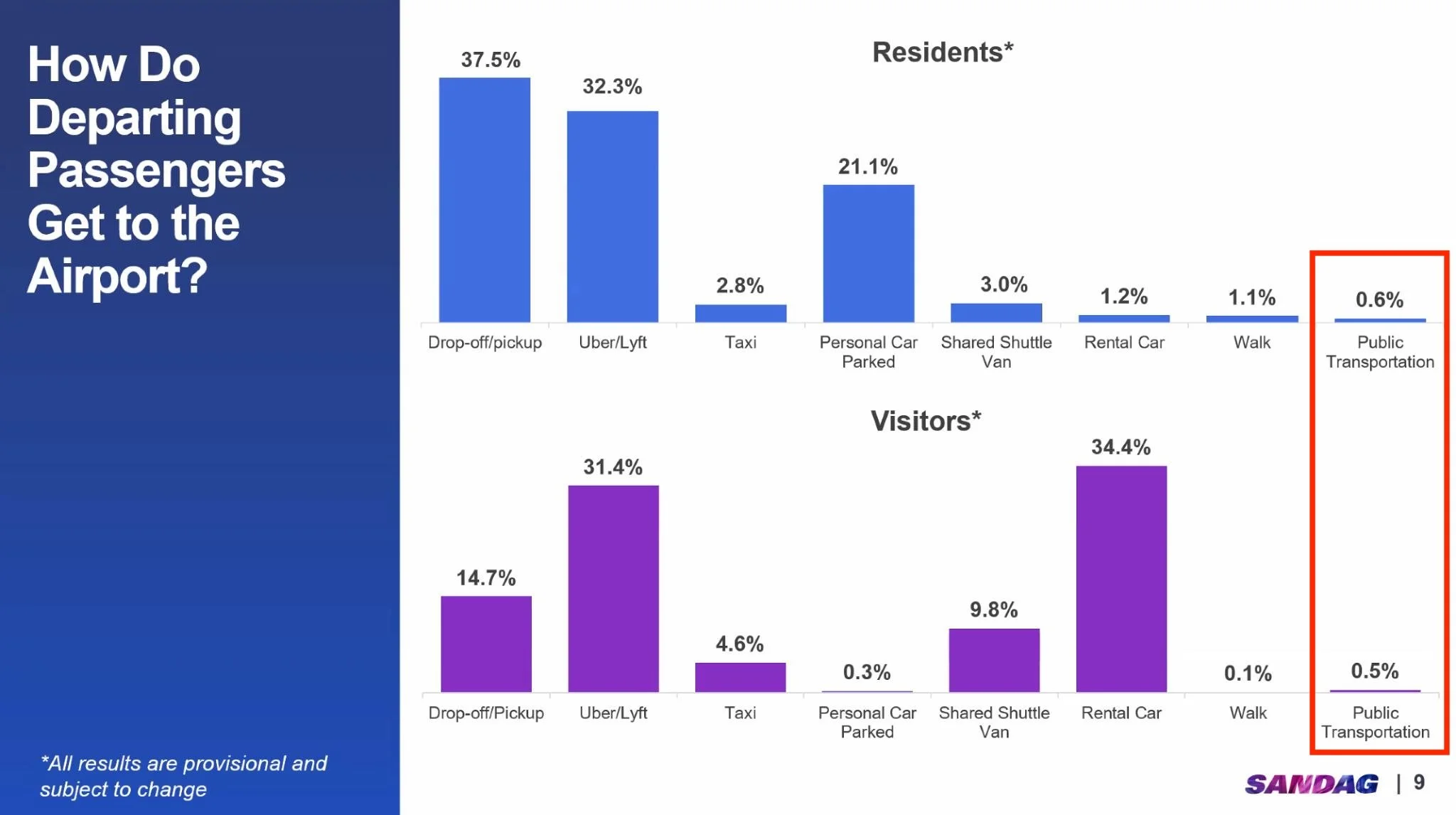
That’s why SANDAG is studying a rail-based Airport Transit Connection to link San Diego’s Airport with Downtown. Only a train, separate from road traffic, can provide the frequency, speed, reliability, and capacity that Airport employees and travelers need. This train will be either a Trolley or an Automated People Mover (APM).
APM vs. Airport Trolley
San Diego’s Trolley, being America’s second-busiest light rail system, is familiar and iconic. At first glance, extending the Trolley to the Airport is appealing. It would enable San Diego to take advantage of existing Trolley technology.
However, RideSD believes that the APM wins on several key metrics.
The APM wins on frequency: it would run up to every two minutes, compared to every 7.5 for the Airport Trolley.
It’s also crucial that SANDAG study how the Airport Transit Connection will impact the Blue and Green Lines. We love airport rail links. But it’s equally important that we don’t compromise on Blue and Green Line capacity.
Airport Trolley Would Reduce Capacity on Existing Lines
The Blue and Green Lines each have a throughput of four trains per hour, per direction (tphpd). However, each already has a maximum capacity of 12 tphpd.
The Airport Trolley would cut each line’s capacity to 8 tphpd. That’s because the Airport Trolley would merge onto existing Blue and Green Line tracks, creating a bottleneck.
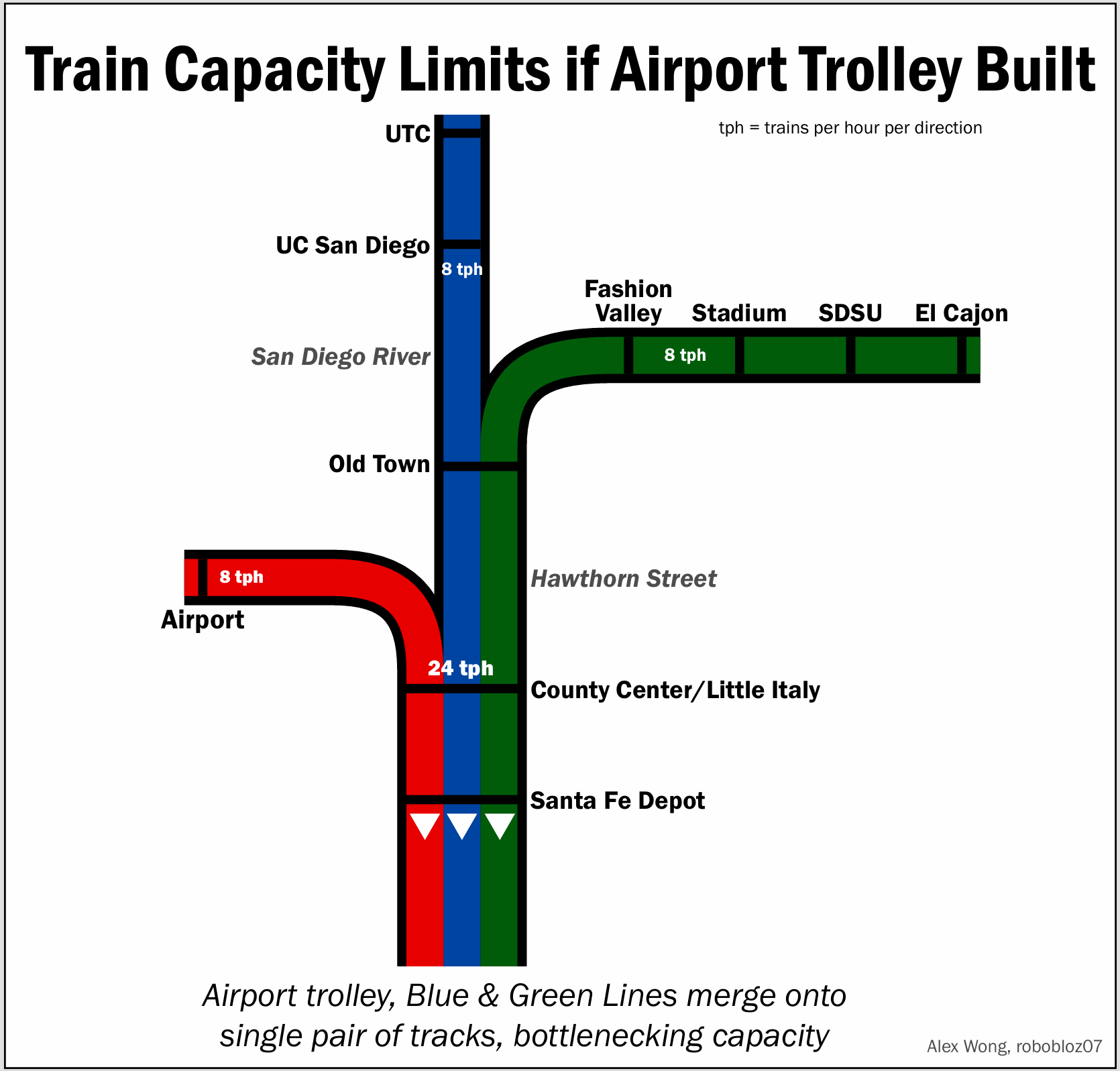
APM Would Maximize Blue, Green Line Capacity
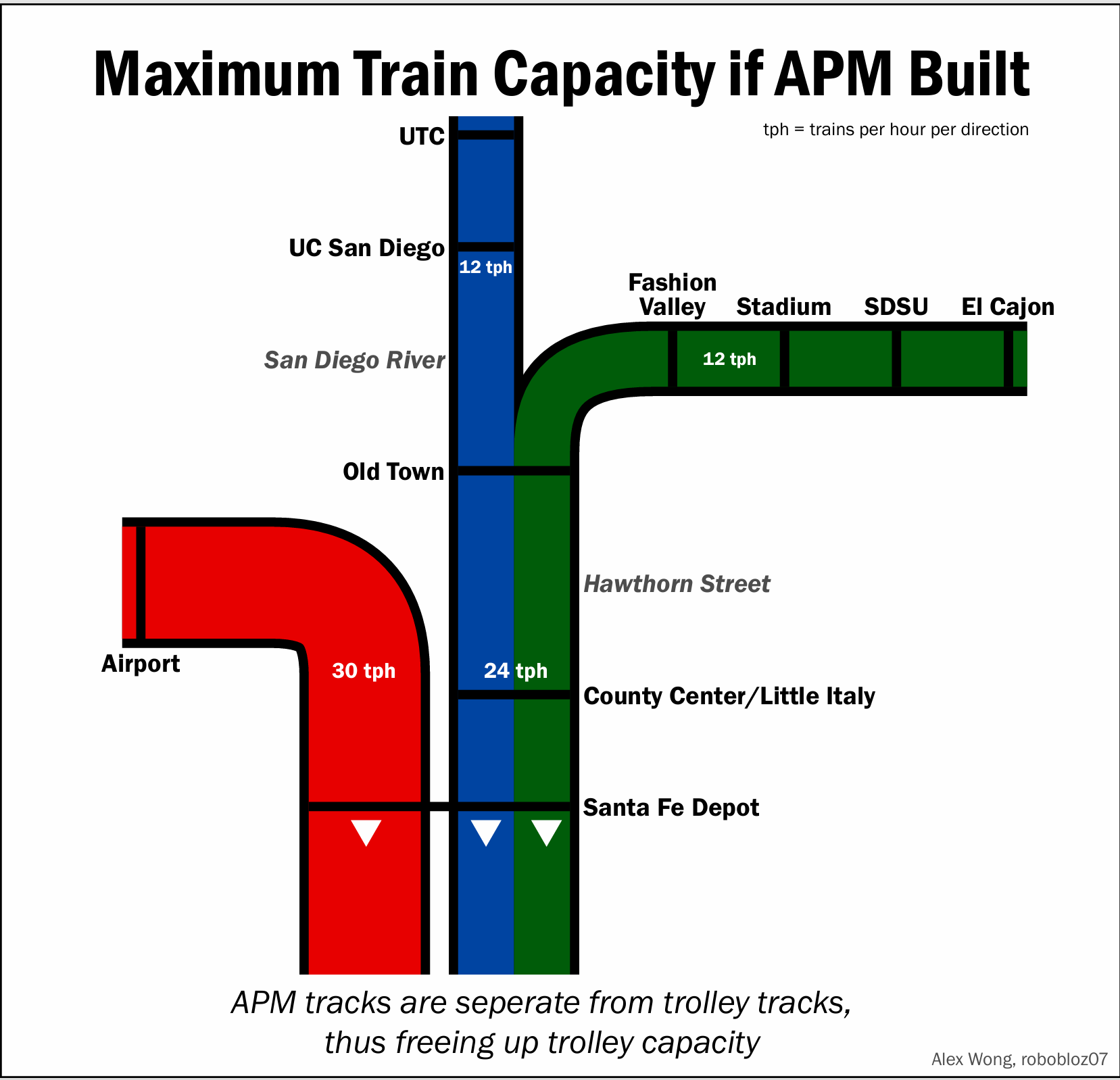
The People Mover would preserve the Mid-Coast and Green Lines’ existing capacity of twelve trains per hour. That’s because people mover tracks would never merge onto Trolley tracks
Maximizing Blue, Green Line Capacity is Crucial
Eight trains per hour is inadequate. Mid-Coast ridership has grown so fast that MTS planned for eight trains per hour by June 2025. And that’s before San Diego approved University City’s plan to add up to 64,200 new residents and 72,000 new jobs. That’s before Clairemont’s plan to add up to 14,000 new homes or Chula Vista’s Bayfront redevelopment.
Green Line ridership will similarly explode, with ridership jumping 7.1% in Fiscal Year 2025 alone. Mission Valley’s approved plan will add up to 50,000 residents, and College Area plans for another 55,000 around SDSU.
Therefore, we need twelve trains per hour to prevent overcrowding. If every other rush hour train is overcrowded, even at 7.5 minute frequencies, people could be waiting for 15 minutes before boarding a train with enough space.
FAQ
What is an Automated People Mover (APM)?
APMs are neither moving walkways nor Tesla tunnels. Rather, people movers refer to driverless trains often used to shuttle passengers between airport terminals. However, many cities have built full-length subway/metro lines using people mover technology.
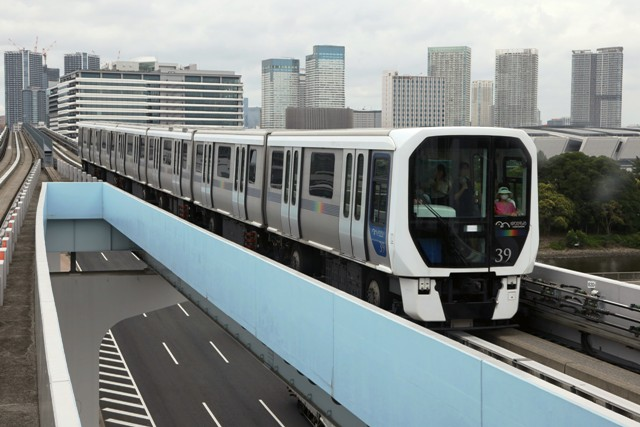
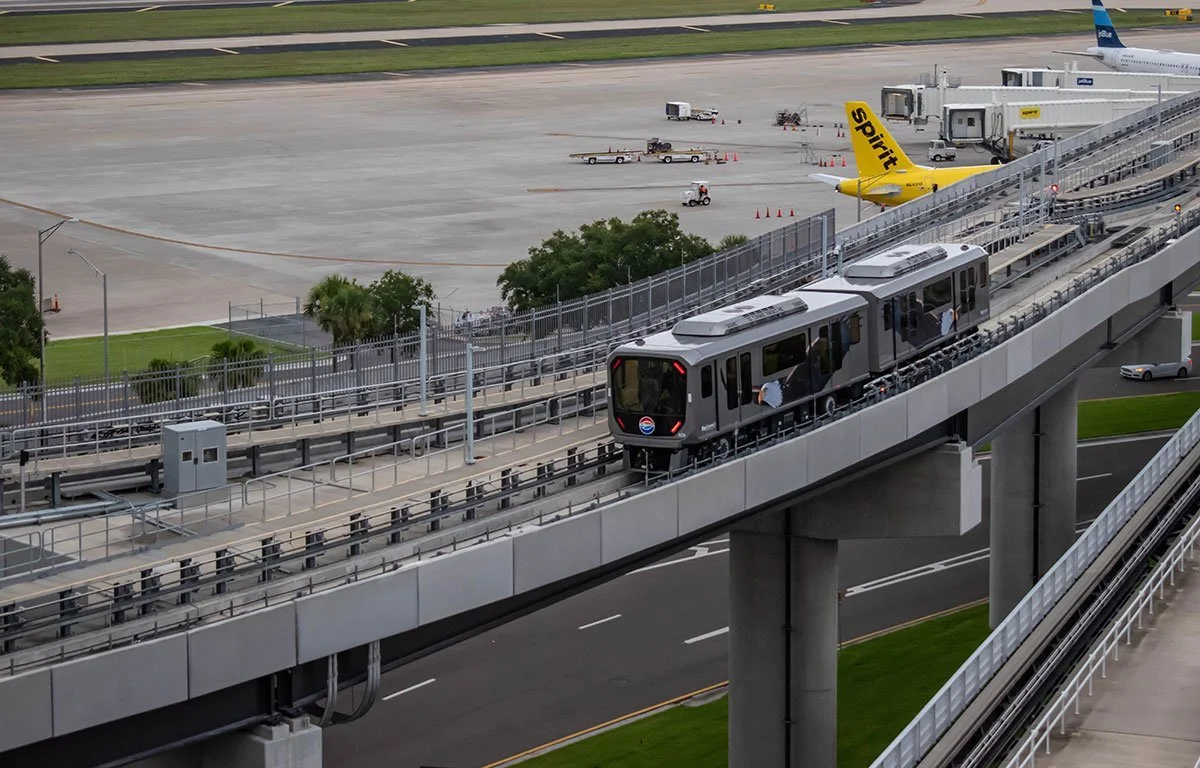
Tokyo’s 9.6-mile Yurikamome (below, 1st picture) runs outside of any airport and uses the same trains as Tampa Airport’s people mover (below, 2nd picture).
Could the APM be extended past the airport to serve Midway and other neighborhoods?
Yes. Vancouver’s Millenium Line (below 1st picture) uses the same trains as New York JFK Airport’s Airtrain (below 2nd picture).
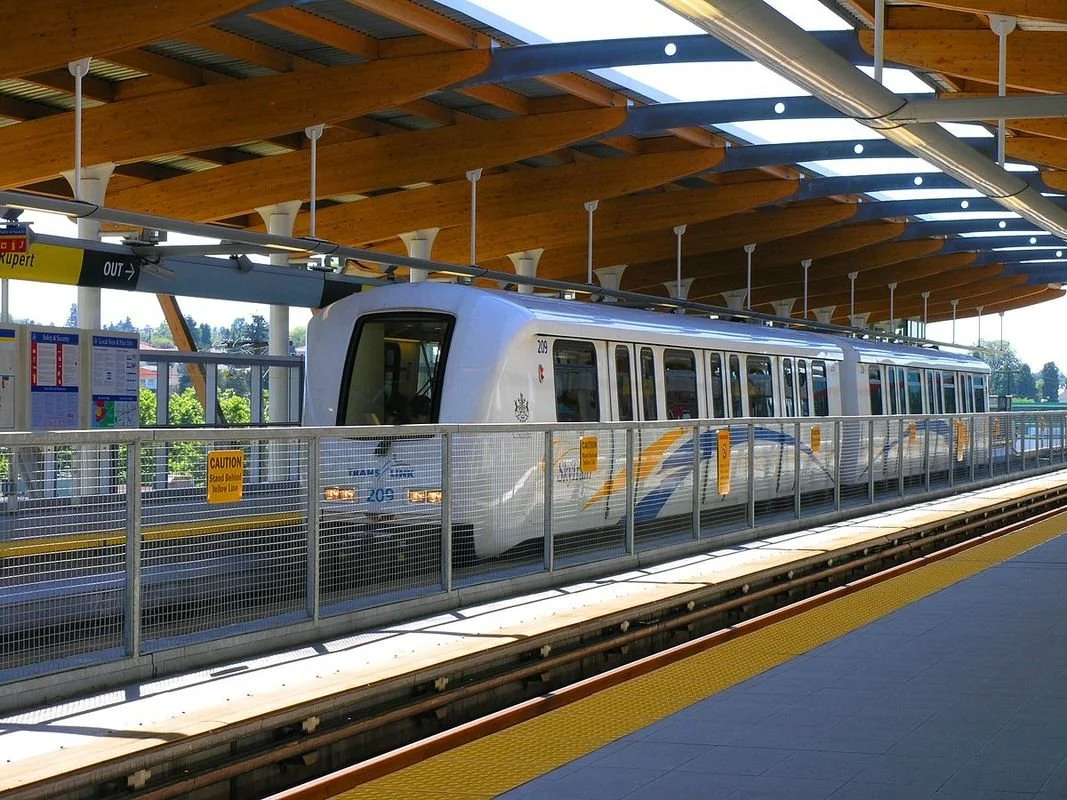
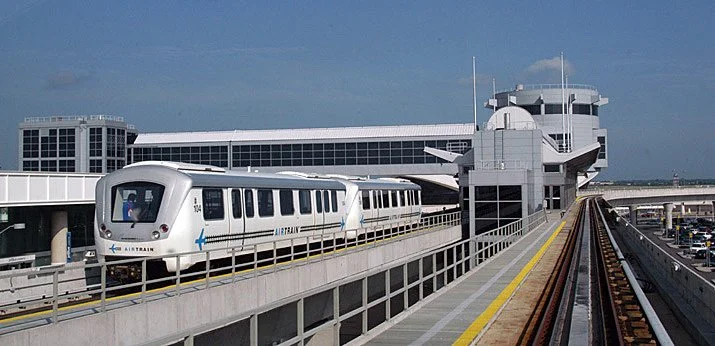
At 22.5 miles, Vancouver’s Millenium Line is already longer than San Diego’s Green Line. And with a 10-mile extension under construction, the Millennium Line will be longer than the Blue Line Trolley.
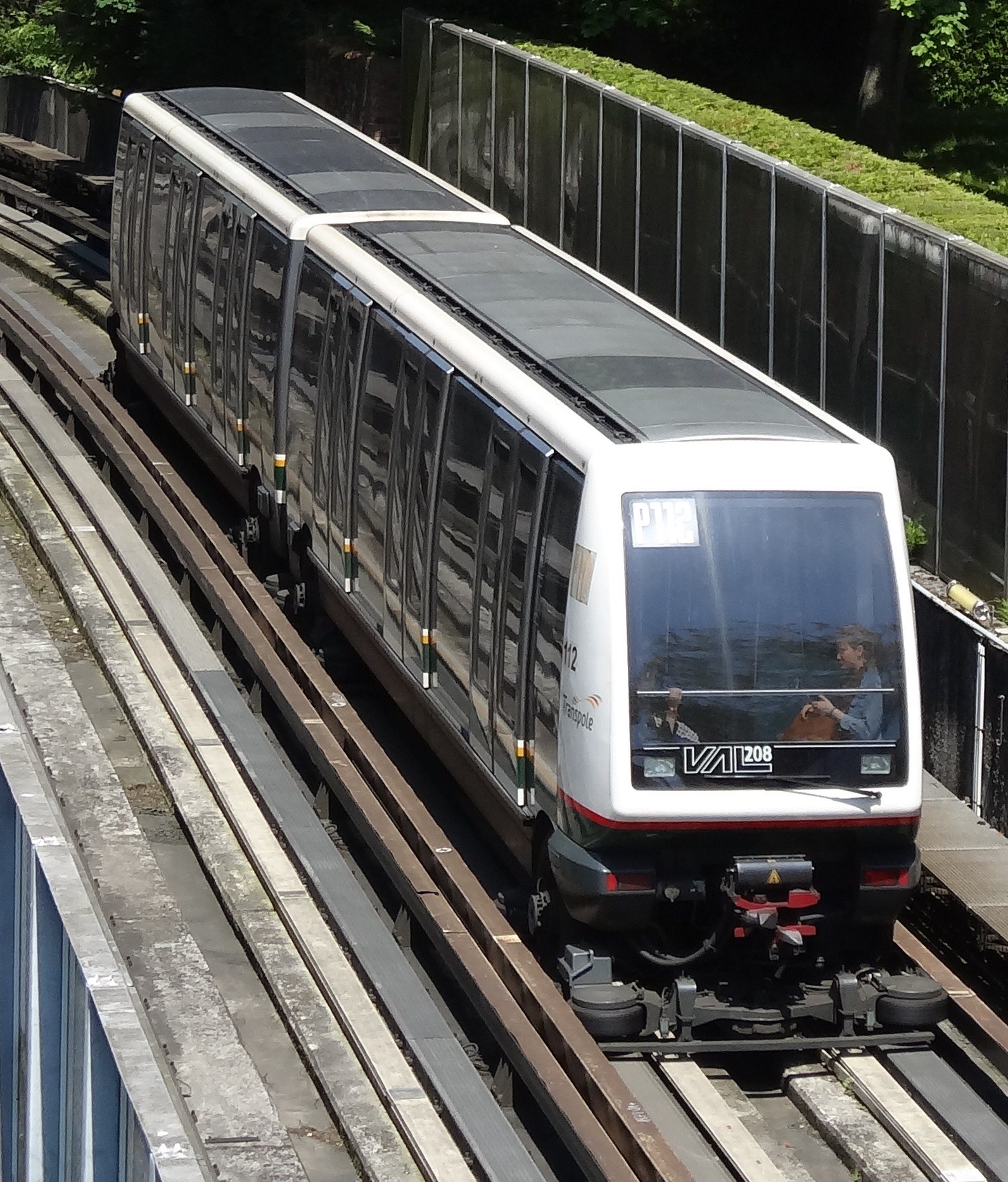
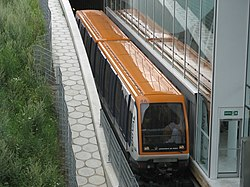
France’s Lille Metro Line 1 (below 1st picture) uses the same trains as Paris CDG Airport’s People Mover (below, 2nd picture)
How Well do People Movers Attract Ridership?
People Movers are typically ridership overachievers. That’s because frequency is often transit riders #1 priority. During rush hour, people movers often run every 2 minutes or better, compared to the Trolley’s 7.5-15 minutes.
Take Vancouver’s Skytrain, which uses the same trains as New York JFK Airport’s people mover. Skytrain boasts 2-3 minute peak hour frequencies and has a ridership nearly quadruple that of the Trolley’s, even though Greater Vancouver’s population is no larger than San Diego County’s.
France’s Toulouse Metro runs up to every 80 seconds using the same trains as Paris CDG Airport’s people movers. Despite Greater Toulouse having less than half the population of San Diego County, in 2023, Toulouse Metro ridership was 112.9 million, while the Trolley had 34 million riders.